Sunday, January 16, 2022

January 12th – The Panama Canal is Busier Than Ever

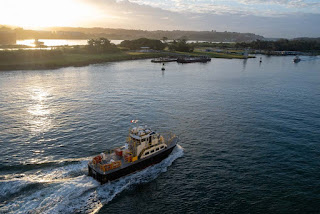
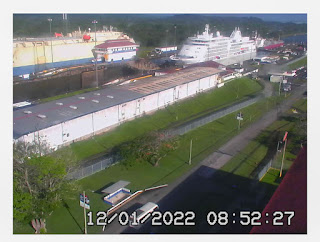
If ever there was a sign that the world is bouncing back from the Pandemic, then it was the sheer volume of traffic that we were sharing the Panama Canal with. If global supply chains have been disrupted, they now appear to be well and truly back on track – as we watched all those massive container ships go past, it made you wonder what was in there, and where it was going (and, whether the world really needs so many manufactured goods to be shipped around the world).

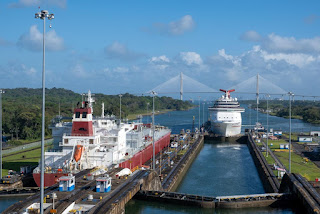
The new locks for the canal were completed in 2016 and they’ve pretty much doubled the capacity of the canal, which meant that we were towered over by some absolutely huge container ships, LNG carriers and supertankers, that wouldn’t have been able to fit through the old locks. The biggest ships pay over $1million to pass through, so the Panamanian government must be doing ok out of it. 

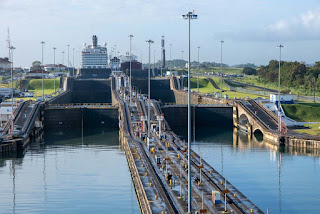
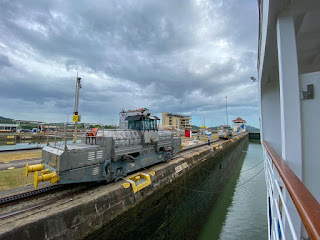
However, we went through the old locks – whose simple but supremely efficient engineering is as awesome now as was when it was completed 108 years ago – they still use the original gates manufactured over a century ago.
For me, the most amazing thing about transiting the canal, is the experience of being on a ship as it’s physically lifted up the 85 feet to the central section of the canal - basically an aquatic bridge that takes you over the mountains from the Atlantic to the Pacific. There are no pumps involved in the gates – just water power and gravity.

A World Cruise is made by the exotic destinations it stops in at, but sometimes just passing through is as good as stopping.


Wednesday, January 12, 2022

January 10th & 11th - Carnival and Coffee in Colonial Cartagena

This is what World Cruising is all about. After 2 years of not leaving Europe, you forget the adrenalin rush of visiting somewhere so utterly different from your own home. And, if you’re looking for an exotic destination with warm tropical weather, amazing history, and a pulsating street life, then Cartagena in Colombia is hard to beat.

You just have to look at the amount of work the Spanish put into protecting this colonial gem of a city back in the 17th and 18th centuries, to know that Cartagena was an incredibly valuable possession. The galleons that set sail from here back to Spain would have been full of precious gold and silver that would be worth hundreds of millions of dollars in today’s money – the values of each ship’s treasures are mind-boggling.


We explored the rambling ramparts of the simply enormous San Felipe Fortress, and walked alongside sections of the 7 miles of thick walls that surrounded the Old Town. And, what they enclosed was pretty special – a superbly-preserved collection of colourful colonial houses, lavish churches, and huge palacios that were so evocative of times gone by.


But, rather than being just a living museum, the thing that marks Cartagena as special is its local colour and vibrant street life. We got a glimpse into this with an amazing World Cruise Event that was full of music and dance – pulsating drums that turned our walk from our outside venue to the restaurant into a full-on street carnival. After so many months of lockdown, this was a joyous sensory overload!


Our second morning here was a much more sedate affair – perking ourselves up with a demonstration of Colombian Coffee. I’m not much of a coffee drinker, but it was interesting to learn about, and it gave me a much-needed boost of caffeine to re-invigorate myself after last night’s energy-sapping fiesta. When your city’s as lively as Cartagena, no wonder the locals are addicted to coffee.


What a great way to start the 2022 World Cruise.


Friday, August 6, 2021

August 6th – Blessed Are The Cheesemakers in Mykonos

Mykonos is famous for its gorgeous beaches, its hedonistic clubs, and its upmarket restaurants, but today we were finding out about another less famous side of this pleasure island – its cheese. Because, as we found out today, there’s a long tradition of cheesemaking on the island, that its Jet-Set visitors probably know nothing about.

We joined another SALT tour (thanks Leandro!) that paid a visit to “Myknonos Farmers” a small-scale enterprise that’s trying to re-introduce traditional island methods into their cheesemaking. The enthusiastic owner Giorgios Syrianos explained that he wanted to replicate what his Grandmother and Mother had done before him, using the best locally-grown produce without any chemicals or additives. He made it sound delightfully simple, and he showed us that simple really is best when it comes to producing tasty and distinctive cheese.

He told us that he wouldn’t produce feta – “you can find that anywhere in Greece, I want something truly local”, so he showed us how he made a ricotta-like cheese, a hard and crumbly one, a gruyere-like one, a boiled cheese, and a distinctively tangy fermented one. Unfortunately I can’t spell or pronounce any of them, so just take my word for it that each one was lovely in its own way.

We thought we were just going for a tasting, but it turned into a full-blown meal, as he rustled up some handmade cheesy-onion ravioli, some hearty pastitsio (the Greek version of lasagne made with long pasta), and a crunchy pastry dessert. All wonderful.

It feels like we’ve been eating non-stop for the last month, so it was appropriate that our final day in the Greek Islands was a day of glorious gluttony. Blessed indeed are the Cheesemakers.


Thursday, August 5, 2021

August 5th – Meeting the Minoans in Heraklion

It was too hot for us to pay a visit to the amazing Palace of Knossos just outside Heraklion (in fact, the site has been shut for a couple of days because of the extreme heat that’s currently roasting Greece), so today we did the next best thing and visited Heraklion’s wonderful Archaeological Museum, which did a great job of filling in the gaps behind the mysterious Minoan civilisation (in the air-conditioned cool too).

As we walked around the exhibits of delicate jewellery, exquisite statues and detailed frescoes from the Minoan era, you constantly had to remind yourself that what we were looking at was at least 3,500 years old. While most of the rest of Europe was living in the stone age (Stonehenge was probably built a couple of hundred years before the Palace of Knossos), here was the first flourishing of western art in Europe’s first ever urban culture.

As we perused the exhibits, we saw echoes of so many designs that were to follow thousands of years later – Picasso’s pottery, Matisse’s cut-outs, Cartier’s jewellery – it all went to show that there’s not much that’s new in the art world, just clever recycling and re-imagining. 

It was fascinating to see that once the Minoan Golden Age had disintegrated (around 1450 BC – from a combination of in-fighting and the effects of the massive eruption at Santorini, the biggest explosion in recorded history), how far backwards the culture went. Unless you have a prosperous and well-organised society, you just don’t have the luxury of time to decorate your pots, or develop artwork.

In fact, as we progressed through the museum, it was obvious that western civilisation had gone into a severe decline for about the next 900 years – it was like we were going backwards through time. Then, of course, the classical period of Ancient Greece started, and the world (and the arts) started going forwards again. This is definitely in the Top 5 Museums in Greece.

The rest of our day was spent enjoying the pleasant atmosphere of modern Heraklion, a town that has a busy buzz, but one that hasn’t given itself over to the tourist trade. To me, this is the most pleasant urban environment in Greece – vibrant streets, good shopping, historic buildings, great restaurants, and….. a wonderful museum.


Tuesday, August 3, 2021

August 3rd – Wining and Dining In Cyprus

When it’s 100F again, it is essential that you keep hydrated. So, fortunately I was joining a tour (on Silversea’s new SALT Programme – Sea and Land Taste), to one of Cyprus’s best wineries to do some sampling of the island’s under-rated wine scene with local expert Florentia Kythreotou.

As we headed up into the hills, it seemed like these parched landscapes would never be able to sustain a wine industry; but, once we’d climbed up to about 800m above sea level, we started to see terraces of green vines. The winery itself – the Oenou Yi Winery in Omodos – was stunning – its white limestone building looking sleek and modern, with amazing views over the valley below.

It was immediately obvious that no expense had been spared on this place – the building was cool and stylish, and the winery equipment all brand-new and state-of-the-art – an investment that showed the owner’s ambition to put Cyprus’s unheralded wine scene on the map. We were greeted by our unbelievably enthusiastic host, Mikhail, who made sure that we had a full wine glass in our hands within seconds of us entering the building. Who cares if it wasn’t even 10am?

Cyprus has been growing vines for hundreds of years; in fact, it was one of the few places in Europe to escape the phylloxera vine pandemic that pretty much wiped out the rest of the continent’s vineyards in the late 19th century. But, until the 1990s, the emphasis had been on quantity not quality, and little importance had been placed on accentuating the unique qualities of the local vines – endemic vines which are able to cope with the island’s extreme heat.

It was fascinating to chat to the vineyard’s young, female wine maker who explained that producing wine is part science, part art – you have to trust the climate, soil and grapes to produce something special, but you use every available piece of science to give it the best chance. From our tastings, they seem to have got that combination spot on.

For me, the rosé and the white were the best – delicate but packing a punch; while the dark red would have been great with a hearty, meaty meal. Every element of this winery showed their enthusiasm to continually improve, and their passion for their business. In fact, it felt like more than a business – it felt like visiting a family proud of its offspring.

By 12pm, we had tasted 5 delicious wines and 1 stupefying zivania, and we were now feeling a little giddy, so it was time to head down into Omodos Village to get some food into our stomachs to soak up all that wine. On the way, we had a demonstration of how they make a local dessert speciality called “Palouze”, a rather gelatinous and sugary mixture that didn’t seem to suit everyone’s tastes. However, the lunch itself was great – loads of different mezze that just kept on coming. It didn’t come as a surprise that it was a pretty quiet coach ride back, as everyone slept off the over-indulgence.

This was a really excellent tour that has made me look at Cypriot wine in a different way – not much gets exported, but it’s worth looking out for.


Sunday, August 1, 2021

August 1st – If You Can’t Stand The Heat In Rhodes…..

…..get into the water. 

Phewee it was hot today – 100F for most of the day. Any breezes blowing were hot and a little smoke-tinged (from fires raging on the Turkish coast – only 11 miles away, just visible through the haze). 

Our idea was to find a museum we had heard about, that supposedly displayed an amazing ancient navigational tool that was well ahead of its time. Unfortunately, no-one had heard of this mythical museum, and it was getting too hot to continue our search – if anyone has heard of it, let me know.

As we walked through the sultry medieval streets of the atmospheric Old Town, we were wondering where all the people had gone – surely it couldn’t just be the pandemic (especially when we know that tourist numbers here are on the rise from our last visit)? But, as we got to Elli Beach (just a 15-minute walk from the ship), it was obvious where all the people were – they'd had the same idea as us, to head to the waters. Actually, most people had a slightly different idea from us, roasting themselves on their sunbeds on the beach, whilst we sheltered in the shade of a bar.

We had headed to a trendy beach bar called Baia whose chilled-out music got steadily more thumping as the day wore on. It was full of attractive, tanned young people, so a couple of deathly-white middle-aged old codgers hardly stood out at all! But, the service was impeccable, the food was good, and the over-priced drinks were cold, and every time the temperature got too hot it was just a short walk to the incredibly turquoise waters to cool down. Bliss!

We’re not normally beach people, but it’s the only place to go on a scorcher like today.